2063Now | July 2026
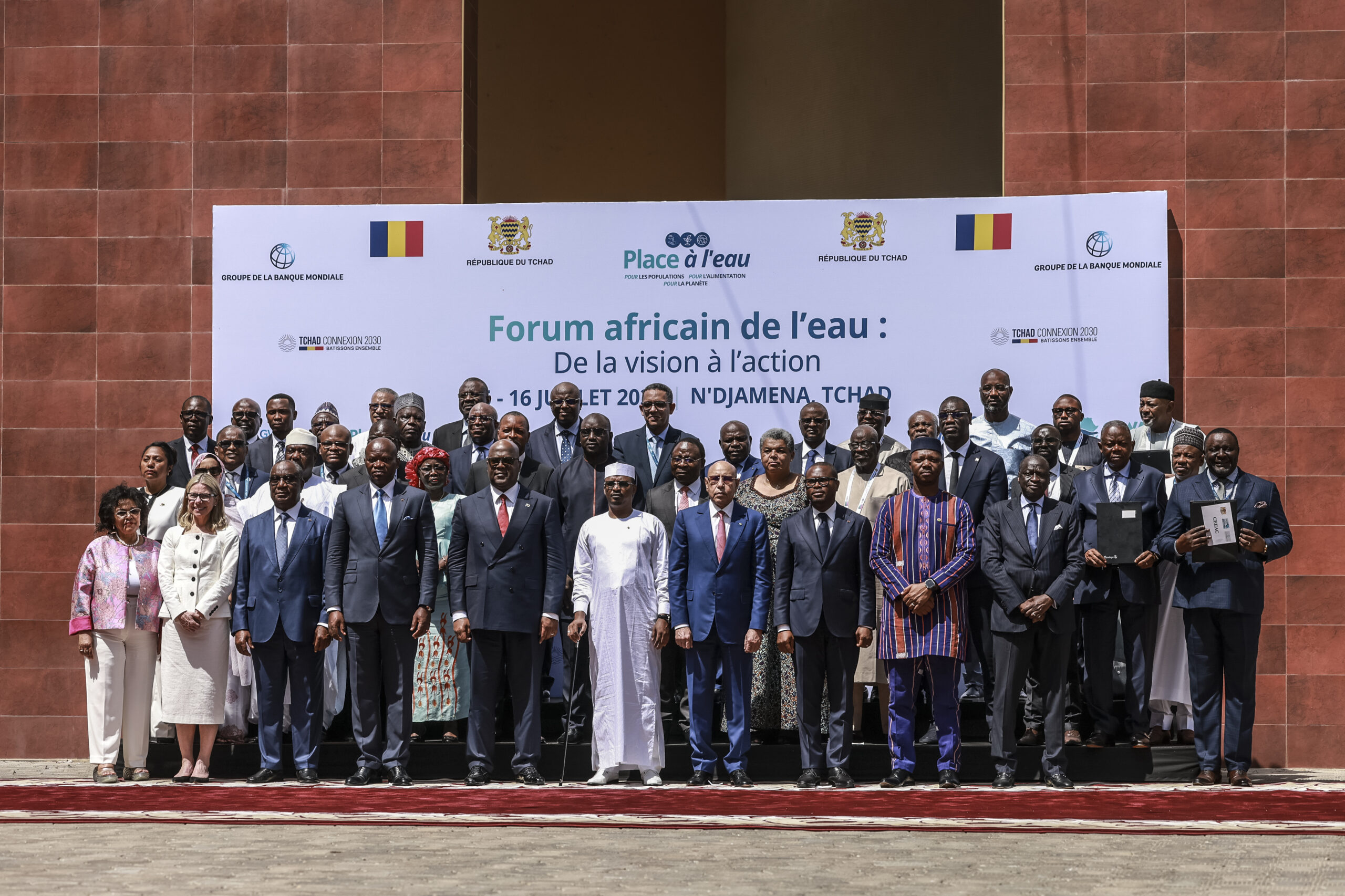
Water has once again become a top priority for African governments and their international partners. The African Union’s adoption of the African Water Vision 2063 in February 2026 places water on the same strategic level as energy, infrastructure, and agriculture [1]. Chad recently hosted, in partnership with the World Bank, the African Water Forum (July 16), following the launch of the international initiative Water Forward, which aims to facilitate access to water for one billion people worldwide by 2030. For its part, Senegal will co-host the United Nations Water Conference (December 8–10).
Moving beyond a purely humanitarian approach focused on people’s access to safe drinking water—which has prevailed in recent decades—the current discourse is now more holistic. These perspectives view water as a critical resource, a catalyst for economic transformation, and a lever for diplomacy and regional integration in the face of growing risks of water-related conflicts—linked to climate, demographic, and geopolitical dynamics—as well as the resilience imperatives of our time.
In this article, 2063Now analyzes how water—a historically local issue—now requires regional or even continental governance, given limited national resources and fragile ecosystems, in order to address the challenges of this century and ensure the prosperity of African nations and their people.
The Challenges of Access to Water: A Human, Economic, and Security Issue
More than sixty years after the era of independence, African countries have not been able to resolve the water crisis. Despite disparities across the continent—with some countries having successfully implemented effective integrated water management models (Morocco, Mauritius, Seychelles)—more than 400 million people still lack access to basic drinking water services, while nearly 700 million lack access to basic sanitation services [2]. The inability to resolve these issues—which stems largely from infrastructure deficiencies—generates significant negative externalities for African populations and economies.
At the population level, access to water and sanitation has been recognized as a fundamental human right under Resolution 64/292, adopted by the United Nations General Assembly on July 28, 2010 [3]. There is therefore a moral imperative for African countries to guarantee access to and security of this resource for their populations. Without equitable access to this resource—which is essential to quality of life, both socially and in terms of health—it seems difficult to sustainably organize the peaceful coexistence of populations.
Beyond the human dignity inherent in access to water, the economic consequences are significant. According to the African Development Bank, deficits in water, sanitation, and hygiene cost Africa at least 4.3% of its GDP each year [4]. The agricultural and industrial sectors cannot compete internationally, process raw materials locally, or create jobs without reliable access to water. For example, less than 10% of arable land on the continent is irrigated, which is particularly detrimental to a sector that accounts for approximately 17% of the continent’s GDP and more than 50% of jobs [5].
Human and economic challenges will be exacerbated by Africa’s population growth—which is expected to double the continent’s population over the next twenty-five years—as well as by the consequences of climate change. Indeed, water scarcity and population displacement will further strain Africa’s water systems, which are already under pressure. These factors will become major sources of conflict in the coming decades if they are not counterbalanced by massive investments in water infrastructure, resilient agriculture, coastal protection, and urban systems. If nothing changes in the management of African river basins, 920 million people could be living in areas at high or very high risk of conflict by 2050 [6].
Shared resources, governance that remains fragmented
While the consequences of water management are inherently local, 90% of the continent’s water resources are shared across national borders. Africa has the largest number of transboundary river basins in the world (63). Major basins such as those of the Nile (11 countries), the Niger (11 to 12 countries), the Congo (9 to 11 countries), and the Zambezi (8 countries) illustrate the need for regional water management on the continent [7].
Despite the creation of some 40 transboundary river basin organizations since the 1960s, cooperation on water issues in Africa remains fragmented. These institutions suffer from weak institutional capacity (limited budgets, insufficient human resources within their secretariats), as well as poorly defined mandates that are not sufficiently focused on project implementation. Furthermore, they do not receive sufficient political support at the highest levels of government, as governments prefer to manage water-related issues individually for reasons of sovereignty. Finally, these organizations lack the political or legal authority to resolve conflicts and disputes among member countries.
In recent years, the most emblematic case has been the dispute between Ethiopia and Egypt over the management of the Nile, particularly due to the construction of hydroelectric dams, including the Grand Ethiopian Renaissance Dam (GERD), which was inaugurated in 2025 [8]. Through this project, Ethiopia’s economic development ambitions—based on increasing its electricity production—clash with Egypt’s considerable water needs to ensure irrigation for its agriculture. Although both countries are members of the Nile Basin Initiative (NBI), tensions show no signs of easing.
Despite these challenges, some examples represent true successes in cross-border partnerships. Established in 1972, the Organization for the Development of the Senegal River (OMVS)—which brings together Senegal, Mali, Mauritania, and Guinea—demonstrates that supranational water governance can be a driver of regional integration [9]. The OMVS convention has systematically implemented the principle of equitable sharing among member states of ownership of the constructed infrastructure as well as the benefits derived from it. Furthermore, it requires prior approval by the contracting states for any project likely to significantly alter the river’s characteristics.
Water at the Heart of African and International Priorities in 2026
The year 2026 could mark a turning point in water management in Africa and generate the momentum needed to ensure access to water, water security, and sanitation for all African populations. The adoption of the African Water Vision 2063 by the heads of state and government of the African Union provides the AU with a genuine continental policy framework that places water on the same strategic level as energy, infrastructure, and agriculture. This framework will support African states seeking to invest more in dams, irrigation systems, drinking water distribution networks, and sanitation infrastructure in order to strengthen their resilience to climate change.
This positive momentum in Africa is in line with international efforts focused on water. With four years remaining until the 2030 Agenda and the Sustainable Development Goals (SDGs) are due to be implemented, international institutions cannot afford to show such poor results relative to the goals they set for themselves if they wish to build a future where multilateralism and international cooperation still have a place. It is in this context that the Water Forward initiative was launched, following the example of Mission 300 for energy in 2025. Launched by the World Bank Group in April 2026, Water Forward aims to improve water security for one billion people by 2030. The initiative seeks to coordinate public policy reforms, investments, and partnerships to sustainably strengthen water systems. Its ambition is to make water a true driver of economic growth, climate resilience, and job creation. The United Nations Water Conference will also be held this year, at the invitation of the United Arab Emirates and Senegal, and will provide a forum for strategic dialogue on these issues. This is the second conference in three years dedicated to water, following a hiatus of nearly half a century since the 1977 conference [10], evidence that water and its governance have returned to the forefront of discussions in a world marked by growing hydro-geopolitical tensions.
A Window of Opportunity to Transform Water Governance
African countries must seize this unique opportunity to advance their agenda on the international stage and harmonize existing African initiatives and organizations in order to create the appropriate mechanisms and platforms for mobilizing domestic and international resources for the water sector. Given the limited resources of African governments and the decline in international cooperation, every concessional, philanthropic, or private resource that can be mobilized for these issues must be channeled into efficient projects capable of sustainably transforming people’s living conditions. Global competition for capital is intensifying, and Africa must not miss this alignment between African and international priorities on this issue, as this window of opportunity may not present itself again.
The intra-African discussions taking place within the framework of the African Water Vision 2063 must lead to the emergence of a genuine African water diplomacy, more cooperation models similar to the Organization for the Development of the Senegal River (OMVS), more win-win partnerships, and increased co-investment and shared ownership among states regarding strategic infrastructure, thereby enabling them to jointly mobilize the necessary domestic and international resources.
Effectively managing Africa’s water challenges this century will require strengthening regional and continental cooperation. A combination of infrastructure investments, reducing water losses in distribution networks, improving irrigation efficiency, reusing wastewater, and strengthening cooperation among river basins would significantly improve water security in many African countries. Water is no longer merely an environmental or humanitarian issue; it is now one of the key determinants of African sovereignty, stability, and prosperity.
Sources & Bibliography
- [1]“African Water Vision 2063”and its related policy, African Ministers’ Council on Water (AMCOW), African Union Commission (AUC) (2026).
- [2] World Bank, 2026
- [3]“The Human Right to Water and Sanitation: Resolution / Adopted by the General Assembly,”UN General Assembly (64th session: 2009–2010)
- [4]“The African Development Bank Group – Water Strategy 2021–2025 | Towards a Water-Secure Africa”African Development Bank
- [5] “African Development Bank Annual Development Effectiveness Review 2026,” AfDB, 2026
- [6] World Bank, UN Conference on Trade and Development
- [7] “Afrotropical Streams and Rivers – Structure, Ecological Processes, and Management,” by Tatenda Dalu and Frank O. Masese (2024)
- [8]“Grand Ethiopian Renaissance Dam: How Africa’s Largest Hydropower Project Is Powering Ethiopia’s Future,” *Water Power & Dam Construction* (2026)
- [9] Organization for the Development of the Senegal River (OMVS)
- [10] United Nations Water Conference, Mar del Plata, March 14–25, 1977
Other Sources on the Topic
- “Navigating the Converging Crises of Water Scarcity, Biodiversity Loss, and Climate Change”Franck Gbaguidi, 2023, Eurasia Group
- “The Water Weapon: How Governance Gaps Are Shaping Risk | LSEG Sustainable Growth”LSEG Sustainable Growth Podcast (May 2026)
- “Why Water Is Africa’s Next Precious Commodity”Bloomberg Next Africa Podcast (March 2026)
Leave a comment